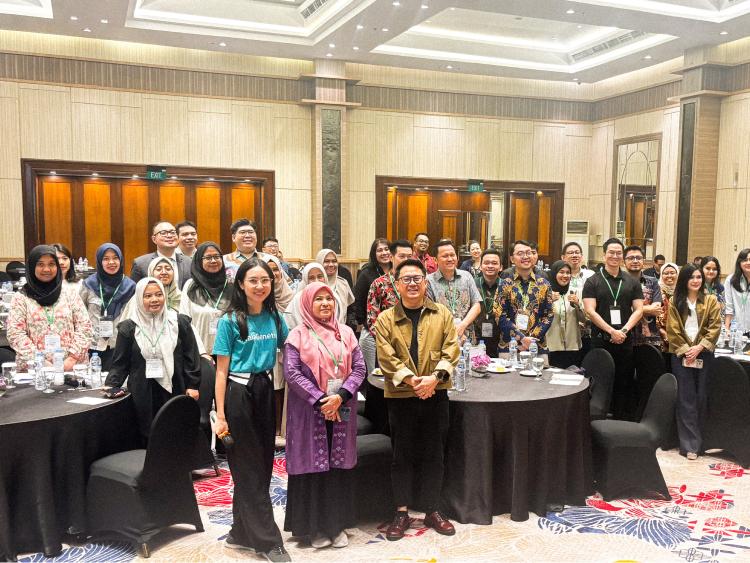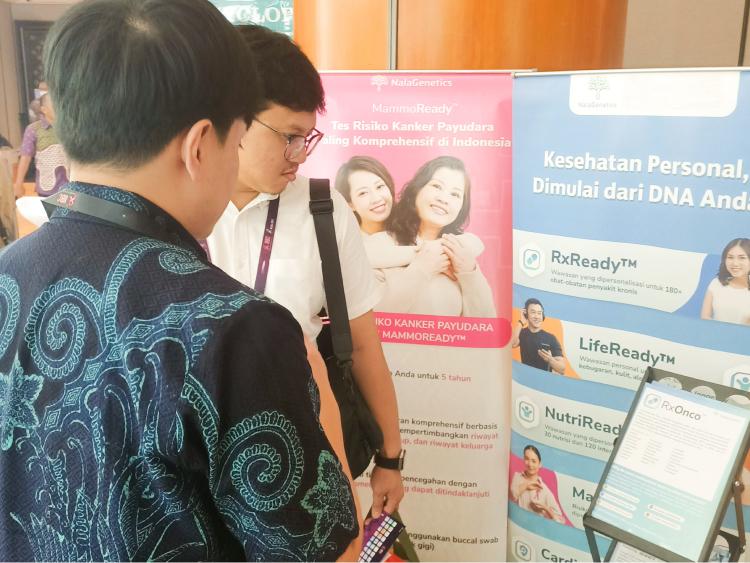
Presented at the GA4GH 14th Plenary
National genome programs and specialist analysis companies each hold something the other needs — the cohort on one side, the interpretation capability on the other. Yet these partnerships routinely stall, and the obstacle is rarely technical.
It’s custody. Once genomes leave a program’s boundary, the custodian can no longer verify what happens to them, and no contract fully restores that visibility. Pharmacogenomics makes the trade sharpest: PGx interpretation rests on curated allele-function knowledge and continuously revised clinical guidelines — expensive to build, expensive to keep current.
So NalaGenetics and the Biomedical and Genome Science Initiative (BGSi) at Indonesia’s Ministry of Health asked a different question: how can a data custodian access specialized bioinformatics capability without relinquishing control over sensitive genomic data?
Move the analysis, not the data
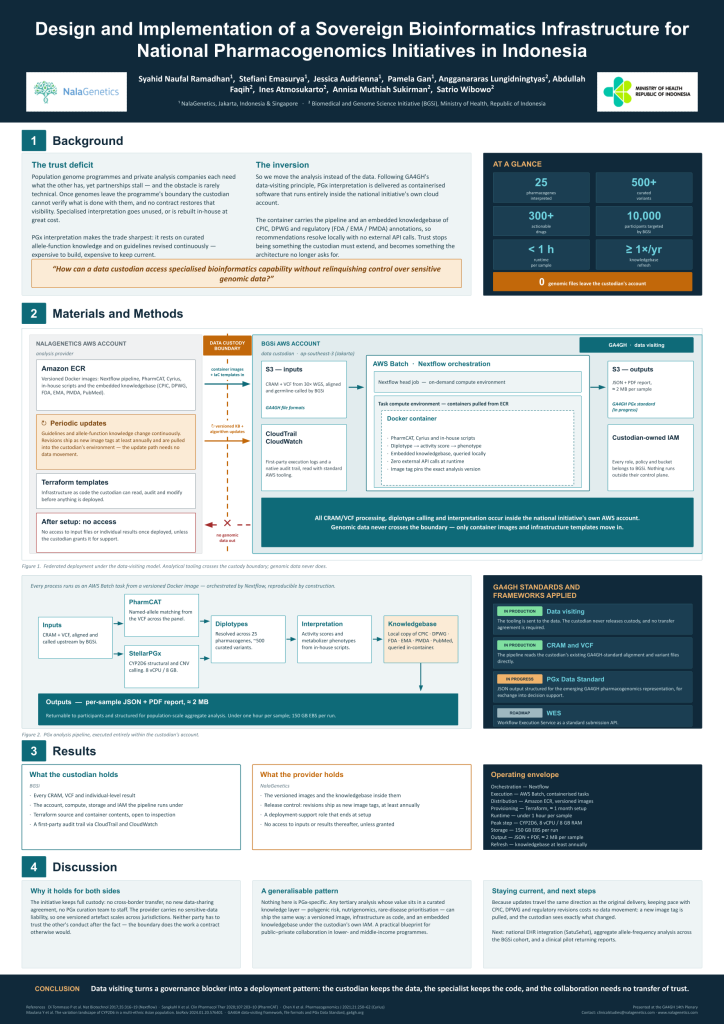
Following GA4GH’s data-visiting principle, PGx interpretation is delivered as containerized software that runs entirely inside the national initiative’s own cloud account. The container carries both the pipeline and an embedded knowledgebase — CPIC, DPWG, and FDA, EMA and PMDA annotations — so recommendations resolve locally with no external API calls at runtime.
Only two things cross the custody boundary, and both move inward: versioned container images and infrastructure-as-code templates. Everything else stays put. CRAM and VCF files sit in BGSi’s own buckets in Jakarta, Nextflow orchestrates AWS Batch tasks inside their account, and every role, policy and bucket belongs to them. Execution logs and the audit trail are first-party, readable with standard AWS tooling.
Trust stops being something the custodian must extend. It becomes something the architecture no longer asks for.
At a glance
- 25 pharmacogenes across ~500 curated variants
- 300+ actionable drugs covered
- 10,000 participants targeted by BGSi
- Under one hour runtime per sample
- Zero genomic files leave the custodian’s account
BGSi retains every CRAM, VCF and individual-level result, plus the Terraform source and container contents, open to inspection. NalaGenetics retains the versioned images and release control — revisions ship as new image tags, at least annually. The deployment-support role ends at setup.
Because updates travel the same direction as the original delivery, staying current with guideline revisions costs no data movement: a new image tag is pulled, and the custodian sees exactly what changed.
A pattern beyond PGx
Nothing here is pharmacogenomics-specific. Any tertiary analysis whose value sits in a curated knowledge layer — polygenic risk, nutrigenomics, rare-disease prioritisation — can ship the same way. For public–private collaboration in lower- and middle-income genomics programmes, where data sovereignty is often the binding constraint, that’s a practical blueprint.
Next: integration with Indonesia’s national EHR system (SatuSehat), aggregate allele-frequency analysis across the BGSi cohort, and a clinical pilot returning reports to participants.